SIEM and SOC integration
Dependably exposes security telemetry that a SIEM can consume, so the registry is watched the same way the rest of your estate is. This page covers what is emitted, which transport carries which events, and how to build a collector that does not silently lose data.
The examples below were run against Wazuh; the mechanics generalize to Splunk, Elastic, Sentinel or anything that reads newline-delimited JSON.
Reference implementation for Wazuh
If Wazuh is your SIEM, you do not have to write rules or a dashboard from scratch.
Download the rules (dependably_rules.xml) and
download the dashboard
(dependably-dashboard.ndjson), then:
- Import the rules: open Server management, then Rules, then Import files, and tick
Overwrite if replacing a previous import. Then restart the manager: an imported
ruleset does not take effect until analysisd restarts, and both
GET /rulesand/logtestreport the rules as active before that restart actually happens, so neither is a reliable check. Confirm with a real search instead, onwazuh-alerts-*, filteringrule.groups:dependably. - Import the dashboard: open Dashboards Management, then Saved objects, then Import. The importer assigns new object ids on every import, so re-importing after an update creates a duplicate rather than replacing the original. Delete the old one.
- Refresh the index pattern's field list once. Open Index patterns, select
wazuh-alerts-*, and click the refresh icon, so panels that read poller-specific fields (like the feed health table) can find them. This is a one-time step; it does not need repeating on subsequent imports.
You need a working collector before either import produces anything. See Setup below first.
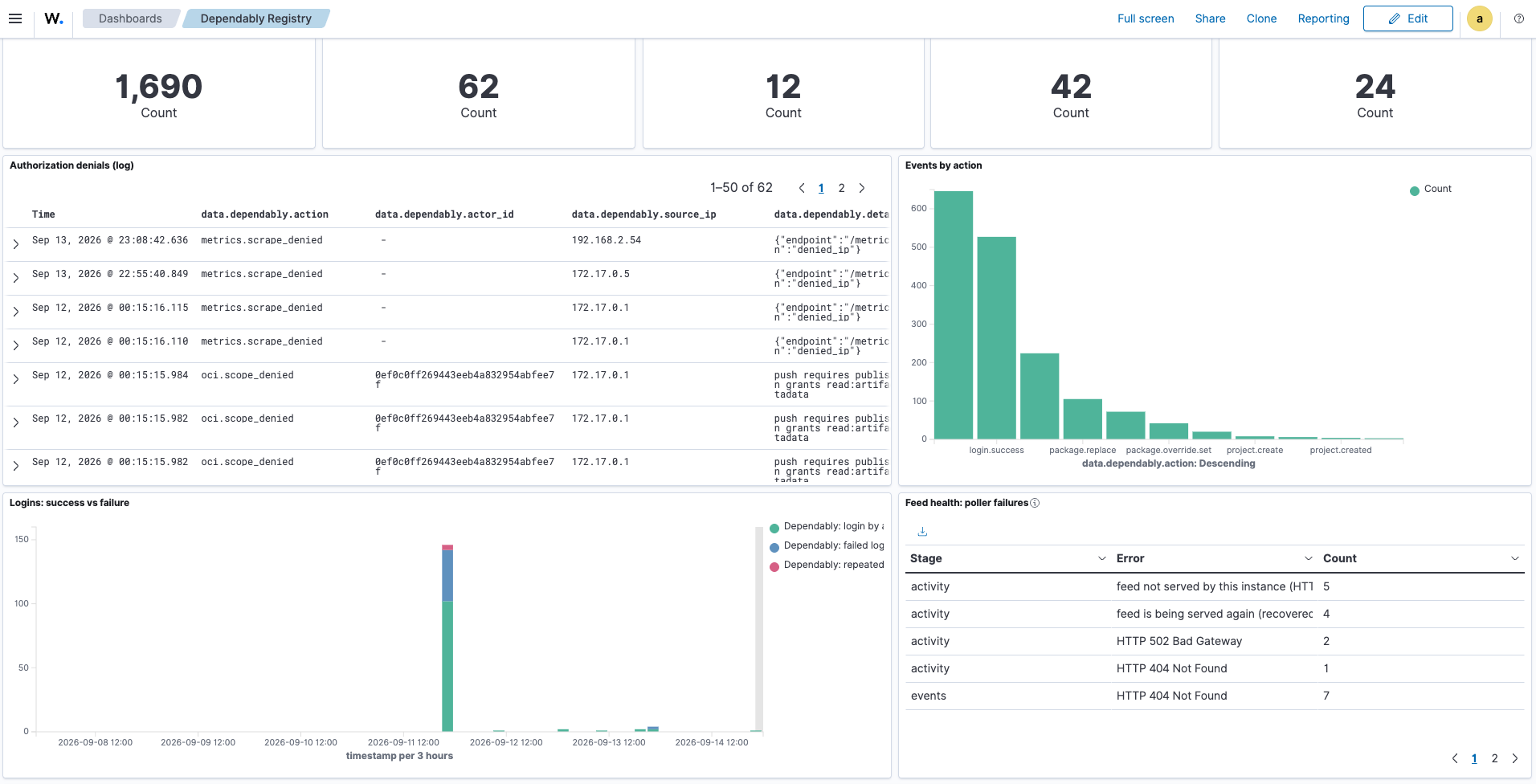
Nothing in the rules or dashboard is homelab-specific; both key off the feed's
own fields (dependably.instance, rule.groups), not a hostname or an agent
name. The rule id space is 100100-100199; renumber before importing if you
already use part of that range.
The pull feeds
/api/v1/siem/events/auth reads the audit_log plane: authentication, credential and capability
refusals, MFA lifecycle, SAML identity changes, security-setting changes.
/api/v1/siem/events/activity reads the activity plane: policy denials (blocked_*, every
block-gate arm) and, behind an opt-in flag, download. Poll both.
Authentication and tenant scope
Both SIEM endpoints accept either a JWT session or a Bearer token carrying the
read:audit capability.
A token is pinned to its own organization. The ?org= parameter is ignored for
token callers (not rejected, ignored), so a token can neither read another tenant's
events nor use the endpoint to discover whether an organization slug exists.
A platform administrator (capability platform:*) can read across tenants on the auth
feed. On the activity feed it must name one organization per poll: that query is scoped
by a non-nullable organization id, so "every tenant at once" is not expressible, and
omitting ?org= is a 400 rather than an unscoped read.
Mint a dedicated token for your collector with read:audit and nothing else.
Setup
Three steps to a working pull collector. None of them needs an instance restart.
1. Mint a collector token
On the Access tokens page, create a token with capability
read:audit and nothing else. The token is pinned to the organization that mints
it; on a multi-tenant instance, mint one per tenant you want to watch.
2. Check the feed answers
curl -sS -H "Authorization: Bearer $DEPENDABLY_AUDIT_TOKEN" \
  "https://repo.example.com/api/v1/siem/events/auth?limit=5"
A 200 carrying an items array is the whole server-side configuration. A 401
means the token is wrong or lacks read:audit; a 403 means it is not permitted on
this instance.
3. Poll both feeds
GET /api/v1/siem/events/auth?since=<iso8601>&until=<iso8601>&limit=500
GET /api/v1/siem/events/activity?since=<iso8601>&until=<iso8601>&limit=500
A platform-admin token must add &org=<slug> to the second. See
Authentication and tenant scope above.
Poll on whatever interval your SOC's detection latency allows; a minute is typical. Everything that makes the difference between a collector that works and one that loses events quietly is in Building a collector that does not lose data. Read that before you ship it.
The events worth alerting on
Every action below is requestable by exact name via a repeatable action= parameter. See
Ask for the actions you want, explicitly for the
filter's matching rule and where to get the full list.
Refusals: a credential or caller was told no
| Action | Fires when | Feed |
|---|---|---|
auth.token.rejected |
a credential was presented and did not resolve. Reasons: invalid, tenant_mismatch |
auth |
auth.capability.denied |
a resolved credential lacked the capability for the operation; carries required vs granted | auth |
oci.scope_denied |
the OCI plane's own, richer form of the same | auth |
ratelimit.rejected |
a request was refused by a rate limiter; aggregated with a count | auth |
metrics.scrape_denied |
an unauthorized /metrics scrape |
auth |
blocked_* |
a pull refused by policy: licence, KEV, malicious, provenance, release age and the rest | activity |
login.failure, lockout.* |
failed sign-in, lockout | auth |
auth.token.rejected with reason=tenant_mismatch is the cross-tenant credential probe: a valid
token from one organization presented against another. The row under the target organization is
deliberately actor-less, because naming the presenting credential there would leak one tenant's
token identity into another tenant's audit trail.
Identity and credential lifecycle
mfa.* (enrolled, disabled, recovery-code used, trusted device added) is a real dotted family:
one action=mfa filter selects all of it. The SAML role and config-change actions look like they
should be families too, but the family filter matches only on the dot: auth.saml.role_assigned
and saml.config_updated split on an underscore, not a dot, so naming auth.saml.role or
saml.config selects nothing. They join user.password_changed, user.email_changed, and the
flat-named token_created, token_revoked, service_token_created, service_token_revoked,
member_role_changed, member_removed, invite_accept_blocked, allowlist_blocked on the list
of actions with no dotted family to inherit through. Name each one individually:
auth.saml.role_assigned, auth.saml.role_changed, auth.saml.role_change_refused,
auth.saml.role_mapping_blocked, saml.config_updated, saml.config_deleted.
Configuration
tenant.setting.change carries the setting key with its before and after values. Treat a change to
an enforcement control (policy mode, signature verification, overwrite policy, MFA or SSO
requirements) differently from a cosmetic one; that is the canonical post-account-takeover step.
Reading partition
Aggregated rows carry a partition identifying who was refused. It uses several namespaces and you
must branch on the prefix rather than parse it as an address: ip: or a bare address,
user:<subject>, token:<reference>, proto:<address>, and <address>:<policy>. Note token:
means different things on different actions: a truncated token id on auth.*, a hash prefix of the
presented credential on ratelimit.*.
Building a collector that does not lose data
Five properties, each of which corresponds to a way a naive collector silently fails.
Advance the watermark only after a fully successful read
Poll [watermark, now], follow next_cursor to exhaustion, and only then move the
watermark to that run's upper bound. If any page fails, leave it alone and re-read
the window next time. The cost is duplicates, which you can absorb; the alternative
is a silent hole nobody ever notices.
De-duplicate on event id
The window is closed on both ends, so re-supplying the previous upper bound as the next lower bound can return one event twice. Keep a small ring of recently emitted ids.
Ask for the actions you want, explicitly
GET /api/v1/siem/actions publishes the whole declared vocabulary: every action name,
which of them the no-filter feed serves (default_actions), the dotted families the
vocabulary implies (family_prefixes), and the two limits on how many values one
request may carry.
The repeatable action filter matches the action of exactly that name, plus every
action in its dotted family. action=checksum_failure selects that one action;
action=auth selects all of auth.*. A trailing separator is optional and ignored,
so action=login. and action=login are the same filter. An unrecognized value is
not an error; it matches nothing, so a collector written against a newer instance
keeps working against an older one.
Name the actions you want rather than inheriting the default. The default set is the
security vocabulary as of the release you are running, and it widens on upgrade, which
means new event types start arriving without anyone deciding they should. Pinning the
set your detections understand is both the safer subscription and the cheaper query:
naming a declared action is free, naming a family or an undeclared name is not. Diff
your pinned list against /api/v1/siem/actions when you upgrade, so a family added in
a release is a decision rather than a surprise.
Two limits apply, both published by that endpoint. One, max_action_filters, bounds
the total values in one request. The other, max_family_filters, bounds how many of
them may be dotted families or names this release does not declare. You will meet
this one first: it is a single budget shared between the families you name
deliberately and any values the instance does not recognize.
Treat your own failure as an event
A dead collector and a quiet registry look identical from the SIEM. Emit a record
when a poll fails, and alert on it. Use latest_event_at in the response envelope.
It reports the most recent event visible to you regardless of your action filter,
which is what distinguishes "my filter matches nothing" from "nothing happened" from
"the writer is broken".
Mark backfilled events so they cannot fake a burst
Most SIEMs correlate on ingest time, not on the event's own timestamp. Replaying history therefore lands months of scattered events in one second and manufactures correlations that never happened. A first run that backfills 24 hours can trip a brute-force rule on traffic that did not occur. Stamp each record with whether it was fresh when collected, and exclude backfilled records from any time-window rule.
Aggregated events and what the count means
Some events are emitted on paths a caller can trigger at will: a rejected credential, a
rate-limit refusal. Writing one audit row per occurrence would let anyone inflate your audit
table and your SIEM bill, so these are coalesced: one row per window carrying a count,
rather than one row per event.
Two consequences your detections must account for.
Counts are per process. Dependably coalesces in memory, so a deployment running several replicas behind a load balancer emits one row per replica per window, each carrying only what that replica saw. Alert on the total across replicas, never on a single row's count. On a multi-replica deployment a single row always reads low, by a factor of roughly the replica count.
Sum rows sharing the same organization, partition, reason and window_start. That works because
the window label is derived from the instant the event was recorded, floored to a fixed wall-clock
interval, not from when a process started or last flushed. Every replica therefore labels the
same event identically, and the sum is the real total.
A burst spanning a boundary is reported as two windows rather than one. That is correct, not a rounding artefact, but a threshold rule of the form "N in one window" will see two smaller windows instead of one large one. Threshold over a rolling range rather than over a single window label.
Resolution degrades under a spray, the total does not. The accumulator is bounded. A caller generating a very large number of distinct keys (many source addresses, say) will first cause new keys to fold into an overflow bucket, and then into a saturation bucket. Those rows are marked as folded. You lose the ability to say which partition each denial came from; you do not lose the fact that they happened, or how many there were.
If you are a tenant rather than the operator, the last-resort saturation rows are written without an organization, so they land in the operator plane and a tenant-scoped collector does not receive them. Under a spray heavy enough to reach saturation, a tenant feed sees the counted overflow rows but not the final fold. Alert on the total and treat the appearance of folded rows as itself a signal: something is generating keys faster than the instance will track them individually.
The payload carries window_start, window_end and a replica identifier so you can group and
sum correctly.
Retention. Audit detail and source_ip are scrubbed after AUDIT_LOG_PII_DAYS (90 by
default). The count, window and partition live in detail, so they do not survive that horizon.
The event's action and ecosystem do. If you need the detail long-term, your SIEM's own
retention is what preserves it, not Dependably's.
Push, for lower latency or a syslog-native SIEM
Everything above is pull: you poll the two endpoints. Dependably can also push, opening an outbound connection of its own to a collector you run, for lower latency or for a SIEM whose native input is a webhook or a syslog listener rather than a REST API to poll. Set one of the two variables below and restart the instance; push runs in addition to pull, never instead of it, since pull is what backfills and survives a collector outage.
| Variable | Default | Effect |
|---|---|---|
SIEM_WEBHOOK_URL |
unset | HTTPS endpoint Dependably POSTs one NDJSON line per event to. A plaintext URL is refused at startup; set SIEM_WEBHOOK_ALLOW_INSECURE=true to allow one anyway. |
SIEM_WEBHOOK_BEARER |
unset | Bearer token sent with each POST, if your collector needs one. |
SIEM_WEBHOOK_ALLOW_PRIVATE |
true |
Set false to require a public collector address instead of an RFC 1918 one. |
SIEM_SYSLOG_HOST |
unset | Syslog receiver hostname. Activates the syslog forwarder; ignored if SIEM_WEBHOOK_URL is also set. |
SIEM_SYSLOG_PORT |
514 |
Syslog receiver port. |
SIEM_SYSLOG_PROTO |
tls |
udp, tcp, or tls. udp and tcp send events in cleartext and log a startup warning naming the exposure. |
SIEM_SYSLOG_FORMAT |
cef |
cef (ArcSight Common Event Format) or rfc5424. |
SIEM_QUEUE_CAPACITY |
1024 |
Outbound queue depth. A full queue drops the event being sent, with a metric, rather than blocking the request that generated it. |
Only one forwarder runs at a time. Setting both SIEM_WEBHOOK_URL and SIEM_SYSLOG_HOST
activates the webhook one.
Push carries less than pull. It has no source_ip, no outcome, no ecosystem or purl, and
its action names are not the ones documented above for the same event: a hosted publish is
push on the pull feed and package.publish on push. Do not try to join pull and push records
by action name. Treat push as a latency add-on and pull as the feed a SOC actually alerts on.
Known limits
Be explicit with your SOC about these rather than letting them discover them.
source_ipis only as good as your proxy configuration, and that has two independent halves: both have to be right, and each fails silently on its own. WhenTRUSTED_PROXIESis unset, Dependably discards forwarded headers by design and records the immediate peer, which behind a reverse proxy or container bridge is the same address for every request; set it to your proxy's address. Separately, your reverse proxy has to actually be configured to sendX-Forwarded-Forin the first place. A proxy that isn't (some GUI-managed reverse-proxy tools default to not forwarding it) leaves nothing forTRUSTED_PROXIESto act on, and the symptom is identical either way: every event shows the proxy's own address. Confirm a fresh event'ssource_ipafter changing either setting; do not assume the fix landed from the config change alone. Once both are correct, per-source brute-force correlation, geo-IP enrichment and IP blocklisting all become usable.- Failed logins carry no actor. A
login.failurerow records neither the account attempted nor an email. You can count a burst; you cannot attribute it. - The feed names actors by identifier, not by name.
orgSlugis served besideorgId, so an alert reads as a tenant rather than a 32-hex id, but actors are not resolved:actorEmailis deliberately always null for user actors, because a denormalized email would be personal data sitting outside the erasure and retention sweeps. Enrich actor identifiers on the SIEM side if your analysts need names. - The feed is a personal-data egress point: forwarded events carry actor identifiers and payloads. If your collector or SIEM sits in another jurisdiction, that is a cross-border transfer to account for under your own compliance regime.